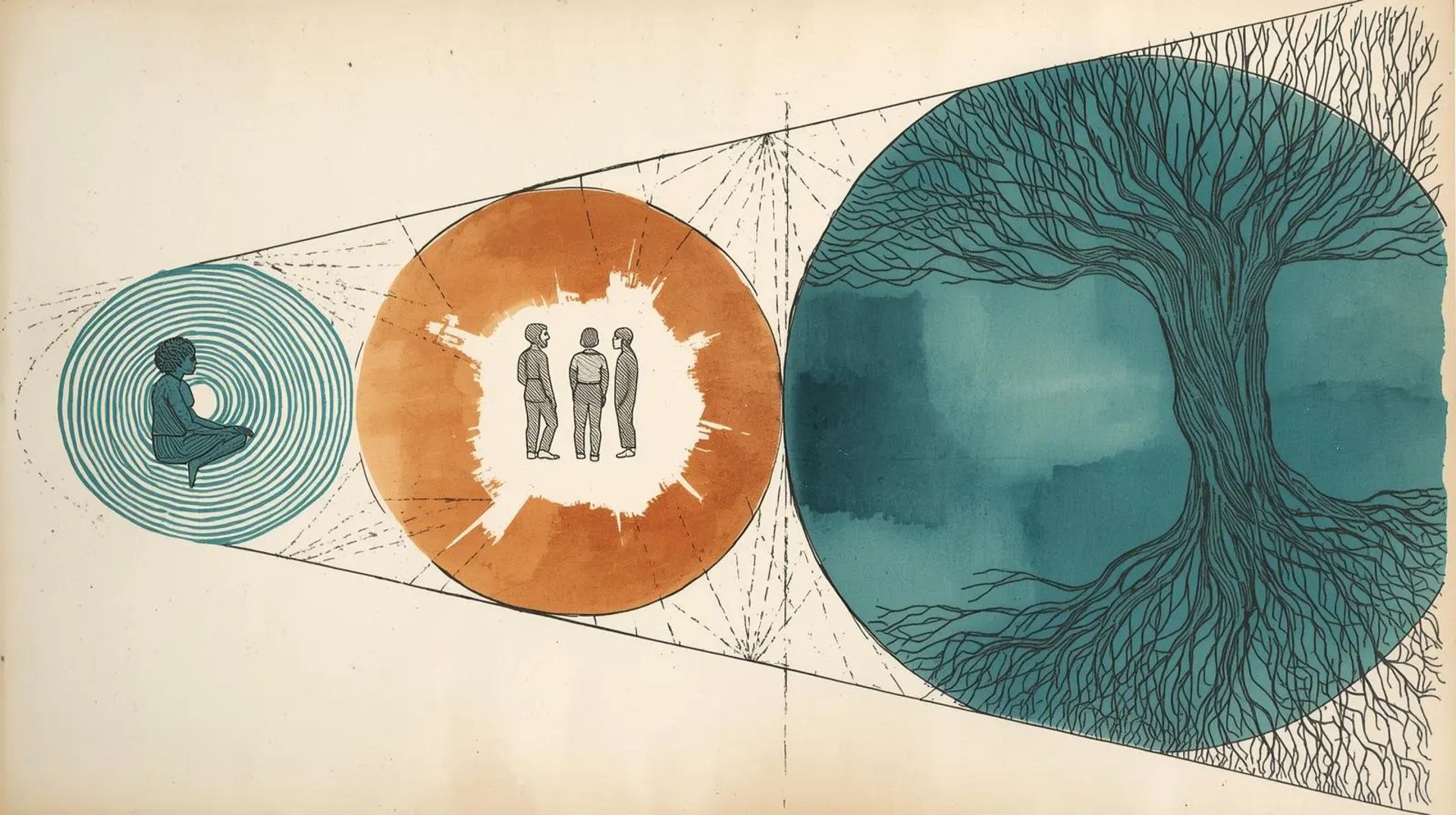
Three Journeys. One Orientation: Go Beneath the Surface
Most services specialise in one layer — mindset, relationships, or organisational systems.
We work across all three, because they shape each other every day
Journey with Self
The most radical thing you can do in a world that profits from your disconnection is to come home to yourself.
This journey is for anyone who seems functional on the outside, but sense something deeper driving the pattern — burnout, indecision, over-control, disconnection, or a quiet knowing that “this isn’t it.”
This is a space for those who feel lost and unsure, burdened, grieving, overwhelmed, unseen or not heard in healing spaces that cannot hold the complexity of their existence.
This is where we journey into the patterns and rhythms driving us and create a space for something new to emerge
Khudi Jagana | Urdu "The Awakening Self"
خودی جگانا
Ukukazi | Zulu "Self-Knowing"
Both traditions point to a self that is not manufactured, but remembered.
Not optimised — awakened.
Journey with Others
You can do all the inner work in the world and still come undone the moment you sit in a room with other people.
That’s not failure. That’s the journey.
This is where we work with what happens when histories sit next to each other — when unspoken dynamics run the room, and a team says they’re fine but everyone can feel that they’re not, when a group struggles to find voice for the unsaid when looking for support or recognition.
This is where the field itself becomes the work.
Sangam | Sanskrit "Confluence- Where Rivers Meet"
संगम
Ukukazi | Setswana "Gathering"
These words come from traditions that understand relationship as generative.
A meeting is not an exchange. It is an event.
Journey with Systems
You can coach every individual in an organisation and nothing changes if the system itself remains untouched. The water stays murky no matter how many you send to therapy.
The Journey with Systems is where we work with the structures, cultures, and unconscious patterns that shape how organisations and communities operate. This is not change management dressed in new language. It’s the willingness to look at what the system is actually doing — who it serves, who it silences, what it rewards, and what it punishes — and to build something more honest from there.
This is where the architecture of the system becomes visible — and therefore changeable.
Naya Nizam | Urdu "New Order"
نظام نیا | नवनियम
Ukwakha Kabusha | Zulu "Building Anew"
Both phrases speak to transformation that is structural, not cosmetic.
Not reform — reconstruction.
Other





Connect
info@samuhasafar.com
+27 (0)76 286 0414
© 2026. All rights reserved.


Root | Reclaim | Reimagine
Collective Journeys
समूह
سفر